
Natural Coconut Sugar Supplier Indonesia: Quality Factors Buyers Should Know

Natural Coconut Sugar is a plant-based sweetener made from coconut blossom sap. Therefore, global food manufacturers use it in processing, blending, and retail repacking. Buyers choose it because it fits natural product positioning and diverse food applications.
Moreover, this sugar plays a stable role in modern food supply chains. Producers process it through evaporation and crystallisation under controlled conditions. As a result, the product keeps its brown colour and mild caramel profile. Consequently, manufacturers apply it in bakery, beverages, sauces, and snack formulations.
In addition, buyers treat coconut sugar as a specialty ingredient rather than refined white sugar. It behaves differently in moisture response and storage handling. Thus, importers must understand quality factors before sourcing. Clear evaluation helps maintain consistent production and stable supply performance.
Understanding Natural Coconut Sugar Characteristics
Natural Coconut Sugar forms through sap collection, heating, and crystallisation. Therefore, farmers and processors directly influence product consistency. Buyers need this knowledge to match industrial application requirements.
Producers collect fresh sap and heat it under controlled conditions. Then, the liquid thickens and forms brown sugar crystals. After that, processors dry and sieve the crystals before packing. This sequence defines the product’s physical characteristics.
Key Characteristics
- Brown colour range from light to dark
- Mild caramel-like taste profile
- Granulated crystal structure
- Higher moisture sensitivity than refined sugar
Furthermore, granulation defines crystal size and usage. Fine granules dissolve quickly in beverages. Meanwhile, standard granules support multi-purpose food production. Coarse granules add texture to toppings and coatings.
Because the sugar absorbs moisture easily, storage control becomes essential. Proper packaging and dry warehousing help maintain flowability. Consequently, buyers can reduce clumping risk during storage and transport.
Quality Indicators in Export-Grade Coconut Sugar
Buyers evaluate coconut sugar using measurable quality indicators. These parameters help maintain stable product performance. Therefore, importers often request laboratory and specification data.
Main Quality Indicators
- Moisture level for flowability and shelf stability
- Colour consistency for product appearance
- Taste stability for formulation control
- Granulation uniformity for mixing efficiency
- Cleanliness and foreign matter control
Lower moisture reduces clumping during storage and shipping. Meanwhile, uniform colour supports consistent visual presentation. A stable mild sweetness with caramel notes helps manufacturers avoid recipe adjustments.
Additionally, even crystal size improves mixing and dissolution. Proper filtration and screening help maintain cleanliness. Therefore, export-grade sugar should meet general food safety expectations.
Processing Methods That Affect Sugar Quality
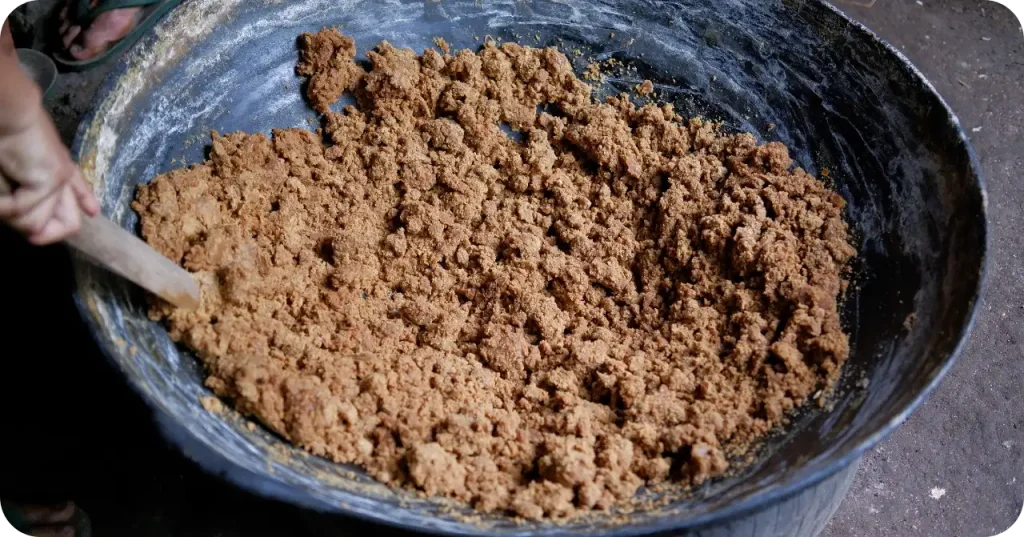
Processing steps directly influence final sugar quality. Therefore, producers apply controlled procedures from sap filtering to drying. Each stage shapes product stability.
Producers first filter fresh sap to remove impurities. Then, they heat the liquid to evaporate water gradually. Temperature control prevents excessive darkening and flavour changes. As a result, processors maintain consistent colour and taste.
After thickening, producers cool the syrup for crystal formation. Next, they dry the crystals to reach target moisture levels. Proper drying improves storage stability and reduces clumping risk. Finally, sieving ensures uniform granulation.
Consequently, structured processing supports batch consistency. Buyers benefit from suppliers who follow monitored procedures. This approach improves reliability in industrial sourcing.
Packaging Standards for International Buyers
Packaging protects coconut sugar from humidity and contamination. Therefore, importers must select export-suitable materials. Proper packaging helps maintain quality during long transit.
Bulk packaging often combines inner plastic liners with outer cartons or sacks. The inner liner acts as a moisture barrier. Meanwhile, the outer layer provides strength for stacking. This structure supports container transport.
Packaging Considerations
- Moisture-barrier inner lining
- Strong outer packaging for stacking
- Clear labelling with batch numbers
- Defined net weight and pallet setup
Some buyers request additional moisture-resistant materials for humid routes. Proper sealing reduces environmental exposure. Consequently, packaging standards support stable product condition upon arrival.
Selecting a Reliable Coconut Sugar Supplier
Importers should evaluate suppliers before long-term sourcing. Reliable partners maintain consistent quality and clear communication. Therefore, buyers usually begin with specification review and sample testing.
Sample evaluation confirms colour, taste, and granulation. Buyers may also conduct laboratory testing. Consistent results build trust in supply reliability. After that, buyers review production capacity and lead time.
Export documentation also plays a key role. Accurate paperwork supports customs clearance. Responsive communication helps solve logistics issues quickly. Many buyers start with trial orders before regular contracts.
Read Also: Buying Natural Coconut Sugar from Indonesian Suppliers: A Practical Guide for Importers
Conclusion and Buyers Consideration
Natural Coconut Sugar from Indonesia supports global food industries as a plant-based sweetener. Buyers evaluate it through characteristics, quality indicators, processing control, and packaging standards. Therefore, structured sourcing helps maintain stable supply and product performance.
Clear specifications, controlled production, and proper packaging reduce handling risk. In addition, reliable suppliers provide consistent documentation and communication. These factors support long-term industrial cooperation.
Companies seeking bulk Natural Coconut Sugar may discuss technical specifications, packaging formats, and shipment planning through professional export channels. For further product information and sourcing discussions, interested buyers can connect through Realsa Natural’s Instagram, LinkedIn, and WhatsApp to explore supply options.
 Realsa Natural – Export Sales